
Engineering Software • Structural Design • ETABS • Civil Engineering
Author: TuitionOn Academic Team | Date: 1 September 2026
Website: TuitionOn.com
What Is a Structural Engineer?
A modern structural engineer does much more than calculate the size of a beam or column. In a real construction project, the structural engineer transforms an architectural concept into a structural system that can safely and economically resist gravity loads, wind, earthquakes and other applicable actions throughout its intended life.
From residential buildings to high-rise towers, hospitals, commercial complexes and industrial structures, structural engineering connects engineering mechanics, materials, structural analysis, design standards, computer modeling, construction requirements and professional judgment.
1. Start With the Load Path—not the Software
One of the most important concepts in structural engineering is the load path. Before opening ETABS, the engineer should understand how the proposed structural system is expected to carry actions.
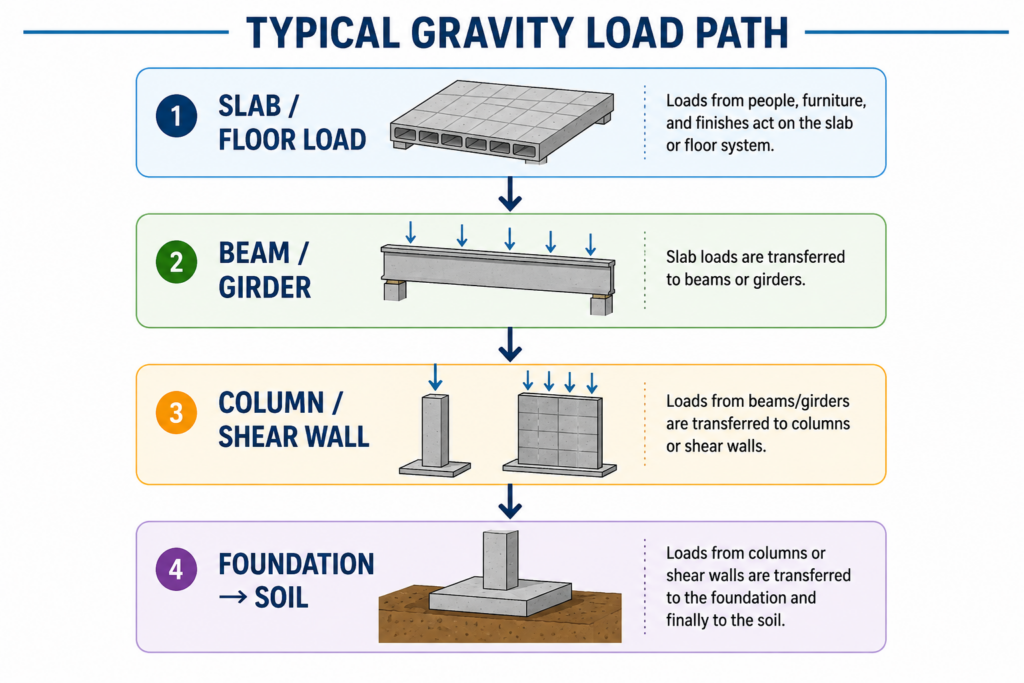
Figure 1. Typical gravity load path from floor system to foundation and soil.
A typical gravity-load path is slab → beam/girder → column or shear wall → foundation → soil. For lateral loading, the path may be wind or earthquake → floor diaphragm → frames/shear walls → foundation → ground.
Thinking in terms of load paths helps engineers detect discontinuities, unexpected load transfer and unrealistic modeling assumptions before analysis begins.
2. Choosing the Structural System
The structural system is influenced by building height, architectural layout, span requirements, occupancy, seismicity, wind environment, material availability, construction method, cost, foundation conditions and local requirements.
- Reinforced-concrete moment frames
- Shear-wall systems
- Dual frame-and-wall systems
- Steel framing and bracing systems
- Composite structural systems
The selected system must be mathematically adequate, constructible, economical and compatible with architectural and building-services requirements.
3. Why ETABS Is Important in Building Structural Design
ETABS, developed by Computers and Structures, Inc. (CSI), is a building analysis and design platform integrating modeling, analysis, design and reporting. Its capabilities cover building systems such as concrete and steel frames, slabs and shear walls.
Typical capabilities used in building projects include 3D modeling, frame and shell elements, diaphragms, static analysis, modal analysis, response-spectrum analysis, time-history analysis, P-Delta analysis, nonlinear analysis, pushover analysis, staged-construction analysis and concrete/steel design.
Official product information: https://www.csiamerica.com/products/etabs
4. The Industry ETABS Workflow
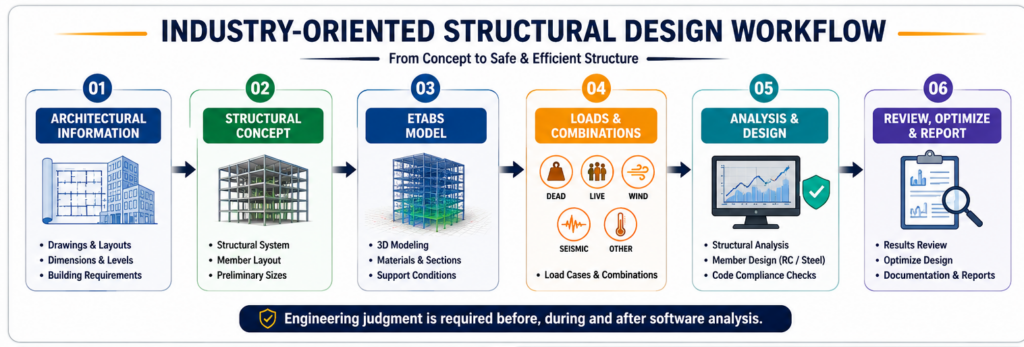
Figure 2. Simplified industry workflow for structural analysis and design.
A professional workflow starts with project information and structural concept development, then moves into model creation, load definition, analysis, design, quality control, optimization and reporting.
- Collect architectural drawings, elevations, sections, grid dimensions, building height, occupancy, material data, geotechnical information and applicable design standards.
- Develop the structural concept: beam and column layout, wall locations, slab system and lateral-force-resisting system.
- Create the analytical model and define materials, sections, frames, walls, slabs, supports, diaphragms and other required properties.
- Define dead, imposed/live, wind, seismic and other applicable load patterns and combinations.
- Run analysis and review structural response.
- Design members and evaluate strength and serviceability requirements.
- Review, optimize and document the final engineering solution.
5. Modeling Is More Important Than Clicking ‘Run Analysis’
A common misconception is that knowing ETABS automatically means knowing structural engineering. The software solves the mathematical model created by the engineer. Therefore, an incorrect model can produce misleading results even when the software calculation itself is correct.
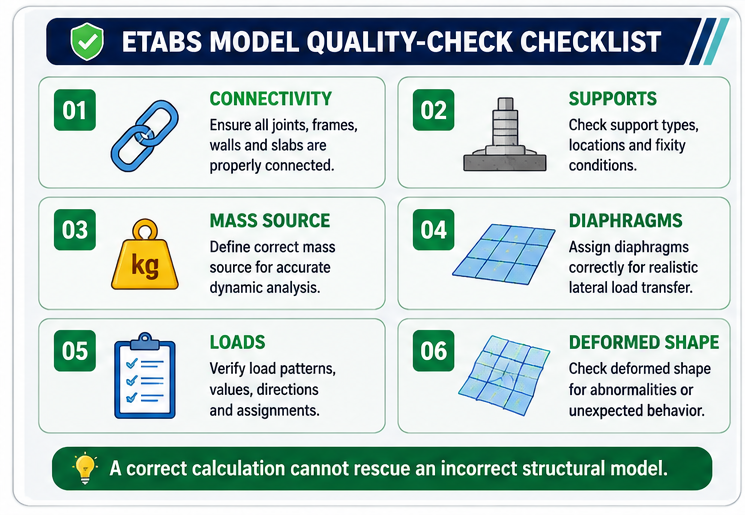
Figure 3. Essential model-quality checks before relying on analysis results.
Engineers should check connectivity, releases, supports, diaphragms, mass source, load assignments, member orientation, wall connectivity, meshing, modal behavior, deformed shape and reactions.
The key principle is simple: software output must be interpreted in the context of the physical structure.
6. Seismic Analysis: Where Structural Engineering Becomes Dynamic
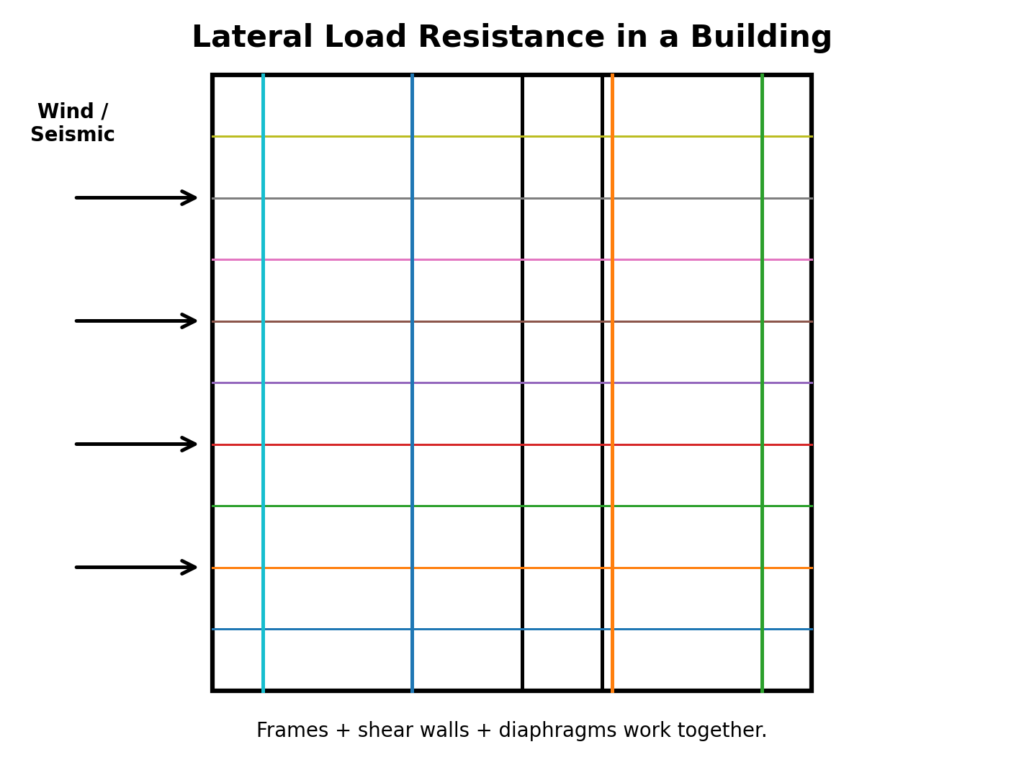
Figure 4. Simplified representation of lateral load resistance through frames, diaphragms and shear walls.
Earthquake engineering requires the building to be treated as a dynamic system. Important concepts include mass, stiffness, natural periods, mode shapes, modal participation, damping, base shear, story drift, torsional response, P-Delta effects, ductility and structural irregularity.
ETABS supports modal, response-spectrum and time-history analysis, along with nonlinear procedures such as pushover analysis. Engineers must understand what each analysis represents and when it is appropriate rather than treating the software command as a substitute for engineering knowledge.
7. P-Delta Effects and Second-Order Behavior
When a laterally displaced structure carries significant axial load, the axial force acting through the displacement can create additional moments. This second-order behavior is commonly associated with P-Delta effects.
Conceptually, the additional moment is related to axial load multiplied by lateral displacement. The significance of the effect depends on the structural system and the applicable design requirements.
8. Concrete Structural Design
For reinforced-concrete buildings, structural engineers may design beams, columns, slabs, shear walls and other supported components. Typical checks include flexure, shear, axial load, interaction of axial load and bending, reinforcement requirements and serviceability considerations.
Software output should be reviewed alongside engineering assumptions, detailing requirements and the governing design standard.
9. Steel Structural Design
For steel buildings, engineers investigate axial capacity, flexural capacity, shear, combined axial and bending effects, buckling, slenderness, effective lengths, unbraced lengths, connection forces and serviceability.
A practical workflow is iterative: trial section → analysis → design check → modify section → re-analysis → final design.
10. Story Drift and Building Performance
Story drift measures relative lateral displacement between floors and is an important performance parameter for buildings subjected to lateral actions. Excessive drift can affect structural and nonstructural components, facades, partitions, building services and occupant comfort.
A structure can satisfy a strength check and still require attention to stiffness and drift. Structural design therefore considers both capacity and performance.
11. Structural Irregularities
Modern buildings can include transfer floors, setbacks, large openings, discontinuous walls, floating columns, large cantilevers, podium structures and uneven stiffness distributions. These features can significantly affect structural behavior.
The engineer should understand how architectural decisions influence the structural load path, stiffness distribution and dynamic response.
12. Structural Engineering Is Also About Coordination
A real project is multidisciplinary. Structural engineers coordinate with architects, MEP engineers, geotechnical engineers, BIM teams, contractors and clients.
- Architectural openings and layouts
- Staircases and elevators
- HVAC, plumbing and electrical systems
- Fire-protection systems
- Facade and cladding requirements
- Equipment and construction constraints
Structural analysis is therefore part of a wider project-delivery process rather than an isolated software exercise.
13. ETABS + SAFE + CAD/BIM: A Practical Skill Set
Industry-oriented structural engineers often work with several tools. ETABS can be paired with SAFE for appropriate floor and foundation workflows, AutoCAD for drawings, Revit for BIM coordination, Excel for engineering calculations and data management, and MATLAB/Python for automation and data processing.
The goal is not to collect software names. The goal is to understand the complete engineering workflow and use each tool appropriately.
14. Industry-Oriented ETABS Projects
- Multi-story reinforced-concrete building: investigate gravity loads, modal response, lateral response, drift and member design.
- High-rise building: study wind/seismic response, P-Delta effects, torsion and drift control.
- Irregular building: compare regular and irregular structural systems using response parameters such as period, base shear, drift and member forces.
- Advanced nonlinear study: compare linear and nonlinear response for a clearly defined structural system and research question.
15. What Should a Structural Engineering Student Learn?
- Structural mechanics: engineering mechanics, strength of materials, structural analysis, matrix methods and finite-element concepts.
- Concrete: reinforced-concrete design, slabs, beams, columns and shear walls.
- Steel: steel design, buckling, connections, bracing and composite structures.
- Dynamics and seismic engineering: structural dynamics, earthquake engineering, modal analysis, response spectrum, time history and performance-based concepts.
- Software: ETABS, SAFE, AutoCAD, Revit, SAP2000 where relevant, Excel and MATLAB/Python where useful.
16. How TuitionOn Can Help Structural Engineering Students
Structural engineering students often need to combine theory, calculations, software and technical reporting. TuitionOn provides academic and technical support options for students working on structural and civil engineering subjects.
- Structural engineering fundamentals and problem-solving guidance
- ETABS learning and structural-modeling guidance
- Load and seismic-analysis concepts
- Concrete and steel design concepts
- Structural project and final-year project guidance
- Engineering assignment and coursework guidance
- Technical report, presentation and viva preparation
- Research and thesis guidance
Explore TuitionOn Services: https://tuitionon.com/services/
17. Structural Engineering Support Worldwide
Structural engineering is studied and practiced across many countries and education systems. Students can explore regional academic-support information through TuitionOn Countries.
Explore TuitionOn Countries: https://tuitionon.com/countries/
For project-specific requirements, students can contact TuitionOn directly: https://tuitionon.com/contact/
18. Need Help With an ETABS or Structural Engineering Project?
When requesting academic guidance, provide the subject, software, building type, academic level, analysis required and deadline. For example: Civil Engineering | ETABS | G+15 RC Building | Master’s Project | Seismic + P-Delta Analysis | Structural Report.
This information helps identify the appropriate academic expertise and makes the requirement easier to understand.
19. Why Structural Engineering Is More Than Software
A software package can calculate forces, generate diagrams, perform analysis and produce design ratios. It cannot replace engineering judgment. The engineer must ask whether the structural system is appropriate, whether assumptions are reasonable, whether the model represents the actual building, whether load paths are logical, whether results are physically realistic and whether the design satisfies the applicable requirements.
These questions separate a software user from a structural engineer.
Conclusion
Modern structural engineering sits at the intersection of mechanics, materials, mathematics, construction, computer modeling and engineering judgment. ETABS has become an important tool for building analysis and design, but the most valuable skill is understanding why a structure behaves the way it does.
A strong industry-oriented workflow moves from hand calculations and structural concepts to ETABS modeling, analysis, design, engineering judgment, optimization and construction documentation.
TuitionOn — Your Ultimate Study Companion
structural engineer, structural engineering, structural design, structural analysis, ETABS, ETABS training, ETABS tutorial, ETABS structural analysis, ETABS structural design, ETABS building design, ETABS seismic analysis, ETABS earthquake analysis, ETABS P Delta analysis, ETABS pushover analysis, ETABS time history analysis, ETABS response spectrum analysis, ETABS concrete design, ETABS steel design, ETABS shear wall design, structural engineering software, structural analysis software, building structural design, civil engineering structural design, reinforced concrete design, steel structure design, high rise building design, seismic structural design, structural modeling, structural engineering projects, ETABS project, civil engineering project help, structural engineering project help, engineering assignment help online, civil engineering assignment help, engineering software training, structural engineering tutor, ETABS tutor, online structural engineering tutor, engineering assignment help online for final year students, best online tutoring service for college students USA, assignment help UAE, assignment help Dubai, affordable assignment help in Saudi Arabia, assignment help for students in Qatar, online academic help for students in Kuwait, dissertation writing help for students in Oman, homework help online for students in Bahrain, assignment help for university students in UK, online assignment help Canada, affordable assignment help for students in Australia, assignment help website for students in Singapore, online homework help for students in Germany, engineering project help online, civil engineering assignment help online, structural engineering assignment help online, ETABS project help online
Suggested Blog Tags
Structural Engineer, Structural Engineering, Structural Design, Structural Analysis, ETABS, ETABS Training, ETABS Tutorial, ETABS Project, ETABS Structural Analysis, ETABS Structural Design, Seismic Analysis, Earthquake Engineering, P Delta Analysis, Pushover Analysis, Response Spectrum Analysis, Concrete Design, Steel Design, Shear Wall Design, High Rise Building Design, Civil Engineering, Structural Engineering Software, Engineering Software, Civil Engineering Projects, Structural Engineering Projects, Engineering Assignment Help, Civil Engineering Assignment Help, Structural Engineering Tutor, ETABS Tutor, Final Year Engineering Project, Online Engineering Tutor, TuitionOn
Official Resource
ETABS — Computers and Structures, Inc. (CSI): https://www.csiamerica.com/products/etabs